“A father sees his newborn son’s white hair. He leaves him on a mountain to die.”
Shahnameh · fathers and sons · mirrors · inherited power
After
the Name
A sculptural installation on power, myth, visibility, fathers, sons, mirrors, and inherited systems.
Concept, Research & Artistic Direction
Movahed MotlaghMaquette Construction & Physical Realisation
Ebrahim EskandariWelcome
In many ancient myths, sons rise up against their fathers.
But in the Shahnameh, the Persian Book of Kings, the opposite happens: fathers abandon, betray, and sacrifice their sons.
Long before these tales, ancient Iranian mythology told of goddesses, queens, and female warriors: Mitra, Anahita, and Azarmidokht.
Power was not only male. Divinity had many faces.
But with the rise of religious ideology, the divine feminine was erased. The patriarch replaced the goddess. And the father became the system.
Stories reflected in the book
Four old wounds, still active.
The project reads the Shahnameh not as distant mythology, but as a structure that still echoes through family, state, and inherited violence.
“A warrior kills a young enemy in battle. Then learns it was his own son.”
“A prince walks through fire to prove his innocence. His father sends him to die in exile.”
“A father promises his son the crown. Then sends him to his death to keep his power.”
These are stories of Zāl, Sohrab, Siavash,
and Esfandiyar.
They are old. But not over.
Statement
The father becomes the system.
This work explores generational betrayal, mirrored power, and the quiet cruelty passed from fathers to sons, from kings to citizens.
In Iran, the system often plays the role of the father.
And the people, especially the youth, are the sons who are punished, sacrificed, or forgotten.
Visual structure
An installation, a mirror, and a structure of power.
The exhibited work uses scale, distance, reflection, and contrasting sculptural forms to turn myth into a spatial system.
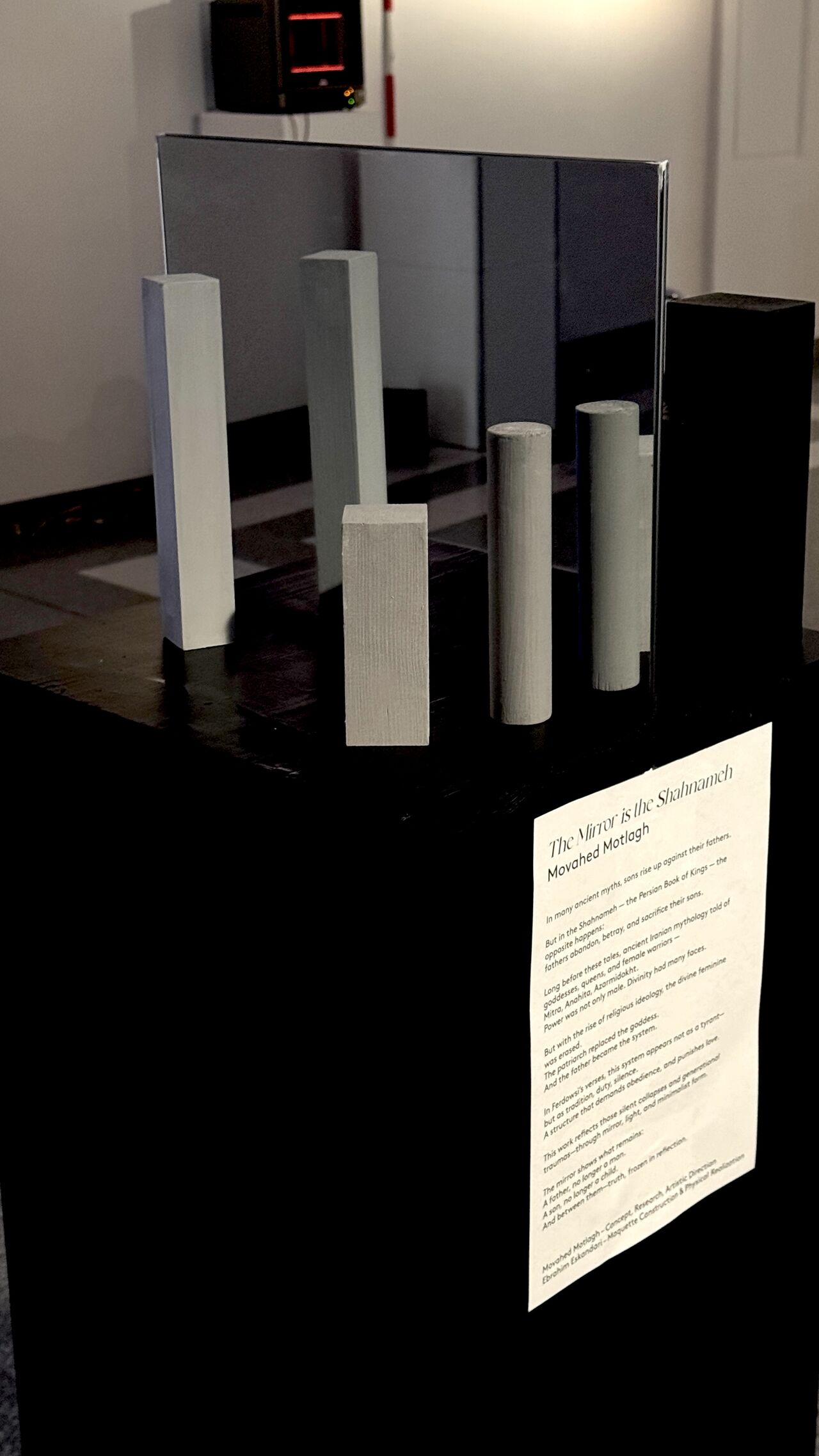
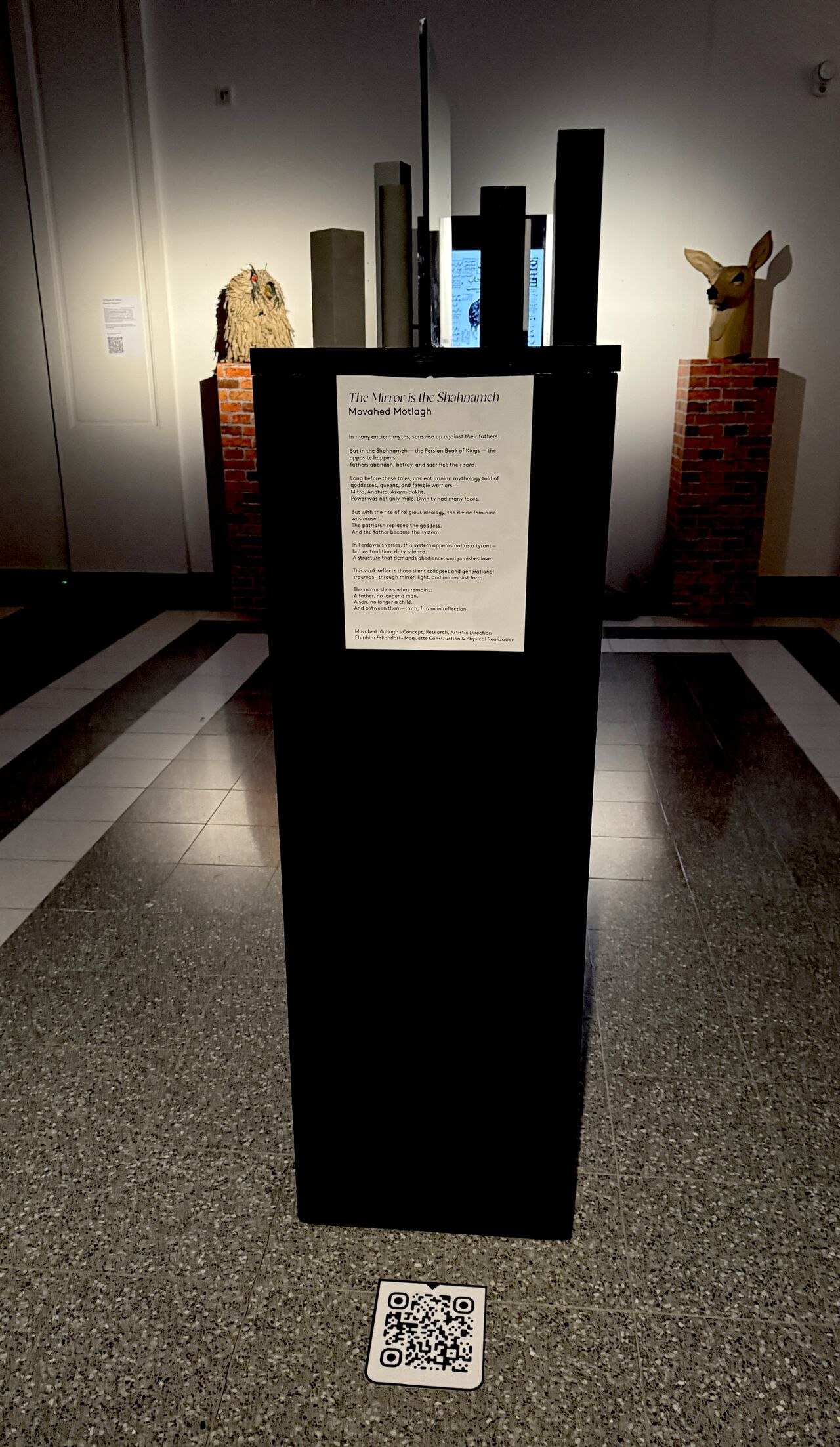
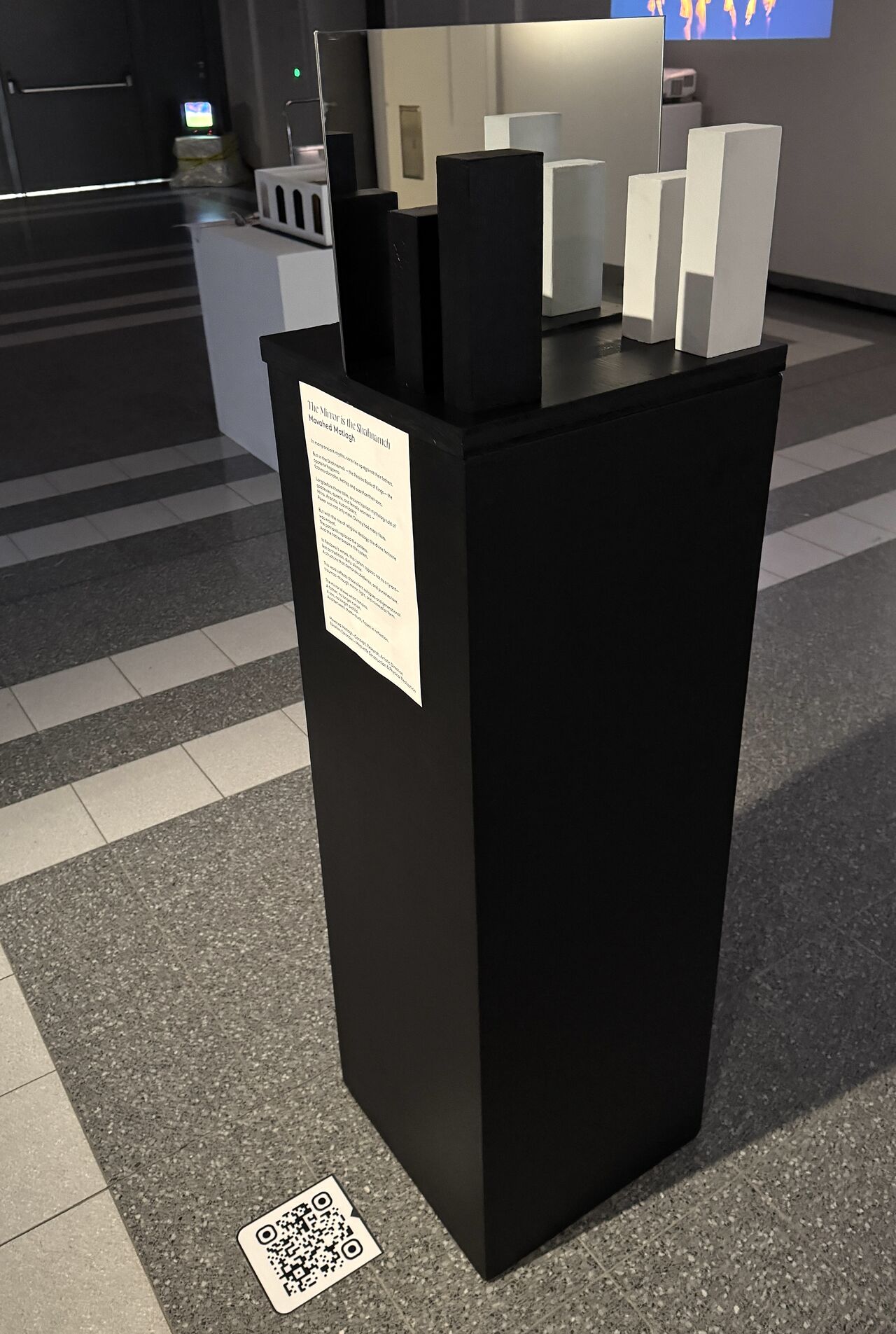
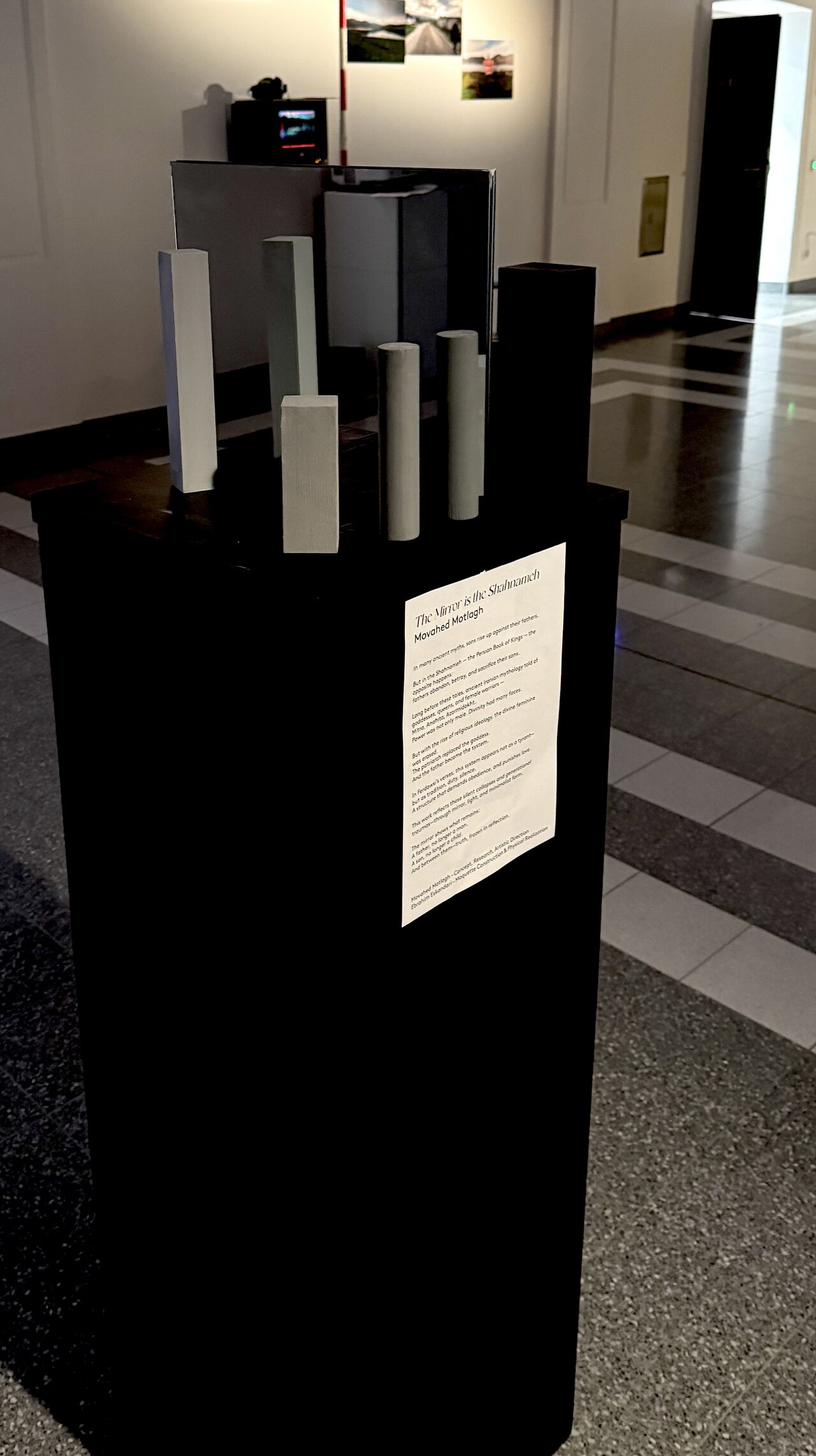
In this work, bigger blocks—the fathers— stand large and near.
Smaller blocks—the sons—stand further away.
But the mirror, like the Shahnameh itself, reverses everything. The sons grow. The fathers diminish.
This is not nostalgia. It is a structure of power still alive today.
The father is now the state. The sons are still being sacrificed.
The reflected forms alter distance, proportion, and hierarchy, allowing power to appear unstable rather than fixed.
The viewer encounters the work through changing angles: looking at the objects, looking into the mirror, and eventually seeing themselves inside the same structure.
Further listening: Coppola on the Shahnameh and The Godfather
Look into the mirror.
Who do you see?
Correspondence